
Parashat Lech-Lecha summary
With two words, lech lecha, the Torah’s focus narrows from all humanity to one family. Avram and Sarai become the first Jewish couple, and the promises G-d makes to them shape the rest of Jewish history.
“Go forth!” Genesis 12:1–9
“Get thee out of thy country, and from thy kindred, and from thy father’s house, unto the land that I will show thee.”Genesis 12:1
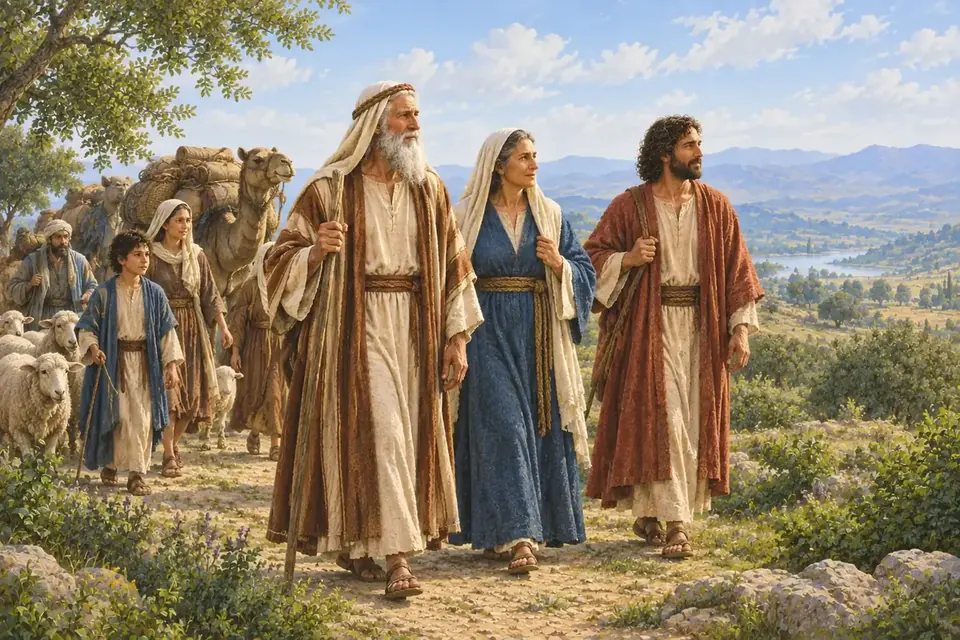
G-d promises to make Avram a great nation and a blessing: “in thee shall all the families of the earth be blessed.” At 75, Avram sets out with Sarai, his nephew Lot, and “the souls that they had gotten in Haran.” Rashi explains this phrase as the people they had brought close to G-d. In Canaan, Avram builds altars and calls out in the name of Hashem. Rashi also reads lech lecha as “go for yourself,” for your own benefit and good.
Famine and Egypt Genesis 12:10–20
A famine (ra’av) drives Avram and Sarai down to Egypt. Afraid for his life, Avram asks Sarai to say she is his sister. Pharaoh takes her into his palace, and G-d strikes Pharaoh’s house with plagues until he returns Sarai and sends them away.
Avram and Lot part ways Genesis 13
Avram and Lot have grown wealthy, and their shepherds quarrel. Avram puts peace first: “Let there be no strife, I pray thee, between me and thee… for we are brethren.” He lets Lot choose first. Lot picks the well-watered Jordan plain near Sodom. G-d tells Avram to lift up his eyes: all the land he sees will belong to his descendants, as many as the dust of the earth. Avram settles near Chevron.
War of the kings, and Malki-Tzedek Genesis 14
Four kings defeat five and carry Lot away. “Avram the Hebrew” (Ivri) sets out with 318 trained men, rescues Lot and brings back the captives. Malki-Tzedek, king of Shalem, greets him with bread and wine and blesses him, and Avram gives him a tenth (ma’aser). When the king of Sodom offers him the spoils, Avram refuses to take “a thread nor a shoe-latchet.”
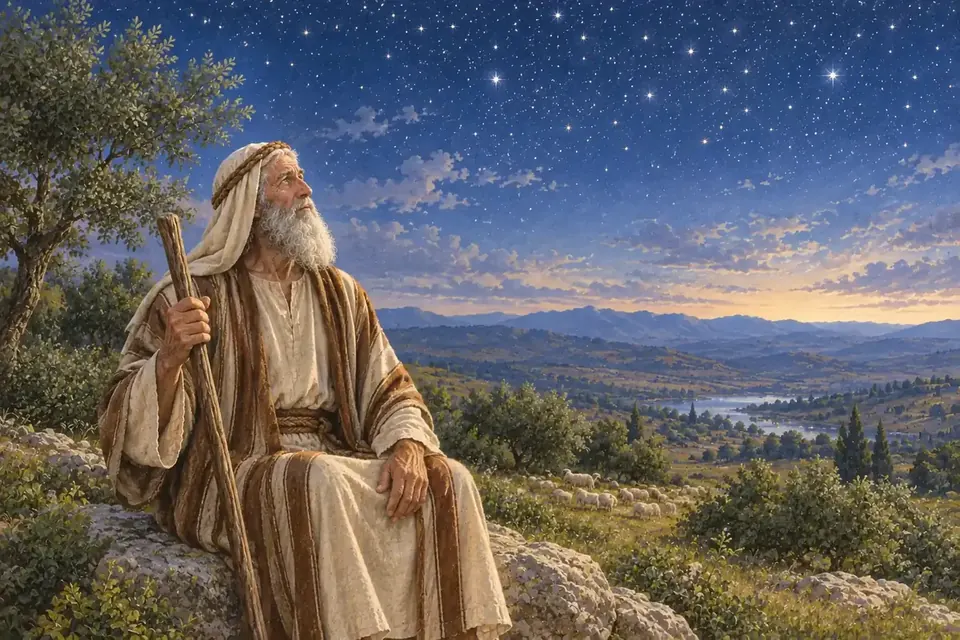
Count the stars Genesis 15
“Fear not, Avram, I am thy shield.” Avram worries that he has no child. G-d takes him outside: “Look now toward heaven, and count the stars… So shall thy seed be.” And Avram believed in Hashem (15:6). In the Covenant Between the Pieces, G-d reveals that Avram’s descendants will be strangers in a land not theirs for four hundred years, and then go free with great wealth.
Sarai and Hagar Genesis 16
Still childless, Sarai gives her maidservant Hagar to Avram as a wife. When Hagar conceives, tension grows between the two women, and Hagar runs away. An angel finds her by a spring in the wilderness, tells her to return, and says her son will be called Yishmael, “G-d hears.” Hagar names G-d El Ro’i, “the G-d who sees me.”
New names and the covenant of milah Genesis 17
When Avram is 99, G-d tells him, “walk before Me, and be thou wholehearted.” Avram becomes Avraham, “father of a multitude of nations,” and Sarai becomes Sarah. G-d makes the covenant of brit milah, circumcision on the eighth day, as an everlasting sign, and promises that Sarah will have a son named Yitzchak (Isaac) the following year. That very day, Avraham, Yishmael and all his household are circumcised.
Key Hebrew words in Parashat Lech-Lecha
You don’t need to know Hebrew to learn Torah, but a handful of key words opens up the text. These are some of the words Lavi teaches in Lech-Lecha, each with its pronunciation and audio in the app.
Big ideas in Parashat Lech-Lecha
- Growth means leaving comfort zones. Avram’s journey starts by letting go of the familiar.
- Faith is trust. Emunah isn’t having every answer; it is trusting G-d’s promise, like Avram under the stars.
- Peace over winning. Avram gives Lot first choice rather than fight. Family matters more than land.
- Courage and integrity. Avram risks his life to rescue Lot, then refuses any reward from the king of Sodom.
- A life of tests. Pirkei Avot (5:3) teaches that Avraham was tested with ten trials and stood firm in all of them. Many of them happen in this parsha.
Questions to think about and discuss
- What would be the hardest thing for you to leave behind if you were told “lech lecha”?
- Avram let Lot choose first to keep the peace. When have you given something up to avoid a fight?
- Why do you think Avram refused the king of Sodom’s reward?
- Hagar called G-d “the One who sees me.” When have you felt truly seen?
These work well at the Shabbat table, with a chavruta (study partner), or on your own. Have a question of your own? You can ask Torah Chat in the Lavi app, and for practical halachic questions, ask your rabbi.
Parashat Lech-Lecha: frequently asked questions
What does “Lech Lecha” mean?
Lech Lecha (לך לך) means “Go forth,” or literally “go for yourself.” Rashi explains that the journey was for Avram’s own benefit and good. These are G-d’s first words to Avram in Genesis 12:1.
What is Parashat Lech-Lecha about?
Parashat Lech-Lecha (Genesis 12:1–17:27) follows Avram’s journey to Canaan, the descent to Egypt, his parting from Lot, the war of the kings, the promise to count the stars, the Covenant Between the Pieces, Hagar and Yishmael, and the covenant of brit milah, when Avram and Sarai become Avraham and Sarah.
Why did Avram’s name change to Avraham?
In Genesis 17:5 G-d adds the letter hei to Avram’s name, making it Avraham, “father of a multitude of nations.” Sarai likewise becomes Sarah. The new names mark the covenant and the promise of their future.
How can I learn Parashat Lech-Lecha?
Read it in short sections, learn key words like lech lecha, emunah and brit, and discuss the questions it raises. Lavi teaches Lech-Lecha in 16 short, illustrated lessons with audio, quizzes and Torah Chat.