
Parashat Noach summary
Noach picks up where Bereshit left off: a world filled with wrongdoing, and one man who still walks with G-d. It is a story about destruction and renewal, and about the promises G-d makes to all of humanity.
A righteous man in a violent world Genesis 6:9–22
“Noah was in his generations a man righteous and wholehearted; Noah walked with G-d.”Genesis 6:9
The earth is filled with chamas, violence and corruption. G-d tells Noah to build a teivah, an ark of gopher wood with three decks and a window, to save his family and the animals. Rashi notes that the Sages read “in his generations” two ways. Some say it is praise: had Noah lived among good people, he would have been even greater. Others say he was righteous only compared to those around him.
Into the ark, and the flood Genesis 7:1–8:14
Noah, his wife, his sons Shem, Ham and Yafet, and their wives enter the ark with the animals. They bring pairs of every kind, and seven pairs of the pure (tahor) animals. Rain falls for forty days and forty nights, and the waters cover even the mountains. Then: “G-d remembered Noah.” A wind passes over the earth, the waters go down, and the ark comes to rest on the mountains of Ararat.
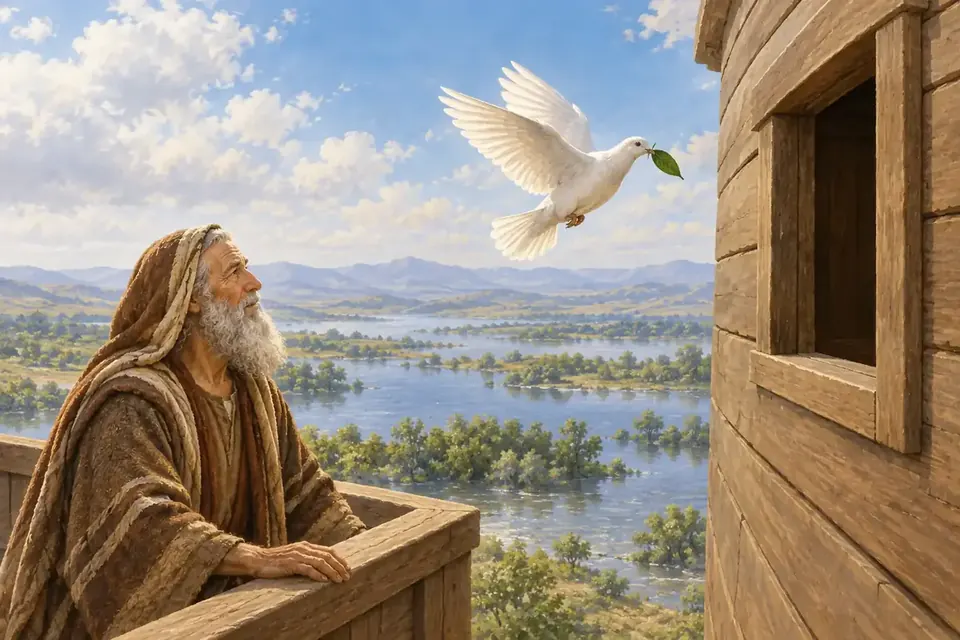
Noah sends out a raven, then a dove. The second time, the dove returns with a freshly plucked olive leaf in her mouth. The waters have gone down. The olive branch has been a symbol of peace and hope ever since.
A new beginning and the rainbow Genesis 8:15–9:17
Noah leaves the ark and builds an altar. G-d promises that “seedtime and harvest, and cold and heat, and summer and winter, and day and night shall not cease.” Humanity is blessed again and given new rules: people may now eat meat, but not blood or a limb from a living animal. And human life is sacred: “for in the image of G-d made He man” (9:6). The Talmud (Sanhedrin 56a) learns the Seven Noahide Laws for all humanity from this section.
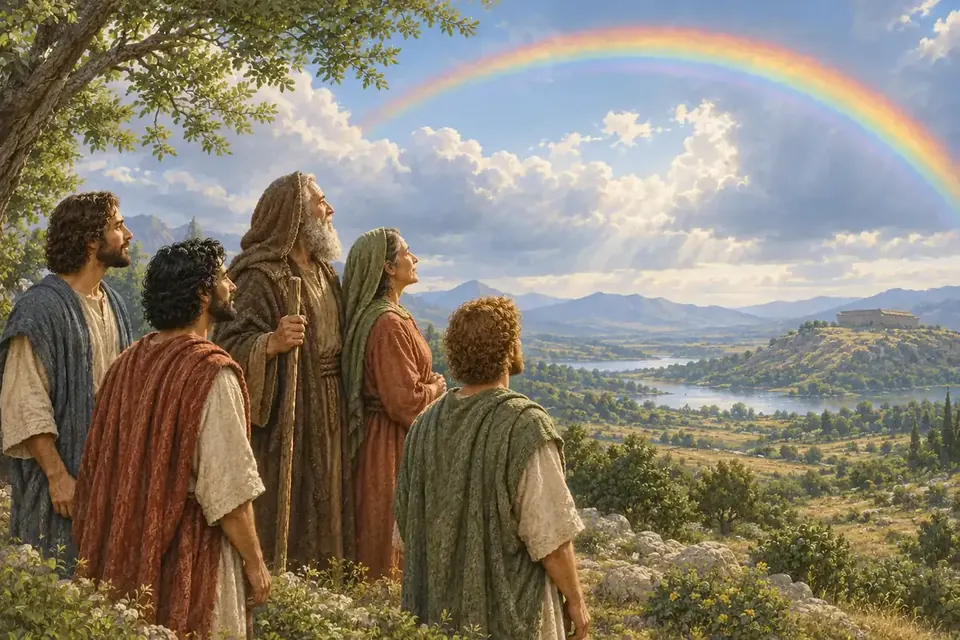
As a sign of His covenant (brit) never again to destroy the world by flood, G-d sets His bow, the rainbow, in the clouds.
Noah’s vineyard Genesis 9:18–29
Noah plants a vineyard, drinks too much wine and lies uncovered in his tent. Ham sees his father’s shame and tells his brothers. Shem and Yafet take a garment, walk in backwards and cover their father without looking, a lasting lesson in protecting another person’s dignity.
Families become nations, and the Tower of Babel Genesis 10:1–11:9
Noah’s descendants spread out and become the nations of the world, traditionally counted as seventy. At that time everyone speaks one language. On a plain in the land of Shinar, people decide to build a city and a tower “with its top in heaven” to “make us a name.” G-d confuses their language and scatters them across the earth. The place is called Bavel (Babel).
From Shem to Avram Genesis 11:10–32
Ten generations lead from Noah to Avram. The parsha closes with Terach’s family: his sons Avram, Nachor and Haran, and Avram’s wife Sarai, who has no child. Terach sets out toward Canaan but settles in Haran. The stage is set for Lech-Lecha.
Key Hebrew words in Parashat Noach
You don’t need to know Hebrew to learn Torah, but a handful of key words opens up the text. These are some of the words Lavi teaches in Noach, each with its pronunciation and audio in the app.
Big ideas in Parashat Noach
- You can be good even when others aren’t. Noah stays righteous in a corrupt generation. Doing right does not depend on the crowd.
- Every human life is sacred. After the flood, G-d’s first laws protect human life, because every person is made in the image of G-d.
- Hope after disaster. The dove, the olive leaf and the rainbow are signs that the world can begin again.
- Unity for the right reasons. The builders of Babel are united, but to “make a name” for themselves. Togetherness is powerful; what matters is what we build with it.
Questions to think about and discuss
- What do you think helped Noah stay good when everyone around him wasn’t?
- Why do you think the dove and the olive leaf became symbols of peace?
- Shem and Yafet protected their father’s dignity without looking. When have you protected someone’s dignity?
- What was wrong with building a tower “to make us a name”? What would a better project have looked like?
These work well at the Shabbat table, with a chavruta (study partner), or on your own. Have a question of your own? You can ask Torah Chat in the Lavi app, and for practical halachic questions, ask your rabbi.
Parashat Noach: frequently asked questions
What is Parashat Noach about?
Parashat Noach (Genesis 6:9–11:32) tells of Noah building the ark, the flood, the dove and the olive leaf, G-d’s rainbow covenant with humanity, Noah’s vineyard, the spread of the nations, the Tower of Babel and the ten generations from Noah to Avram.
What are the Seven Noahide Laws?
According to the Talmud (Sanhedrin 56a), the Seven Noahide Laws apply to all humanity: do not worship idols, do not curse G-d, do not murder, do not commit forbidden relations, do not steal, do not eat a limb from a living animal, and establish courts of justice.
Why is the rainbow important in Judaism?
In Parashat Noach the rainbow is the sign of G-d’s covenant never again to destroy the world by flood (Genesis 9:13). Jewish tradition has a special blessing to say on seeing a rainbow, recalling that covenant.
How can I learn Parashat Noach?
Read a few verses at a time, learn key words like teivah, brit and keshet, and talk about the big questions. Lavi teaches Noach in 15 short, illustrated lessons with audio, quizzes and Torah Chat.